Why NGINX Is Still So Popular in Modern Architectures
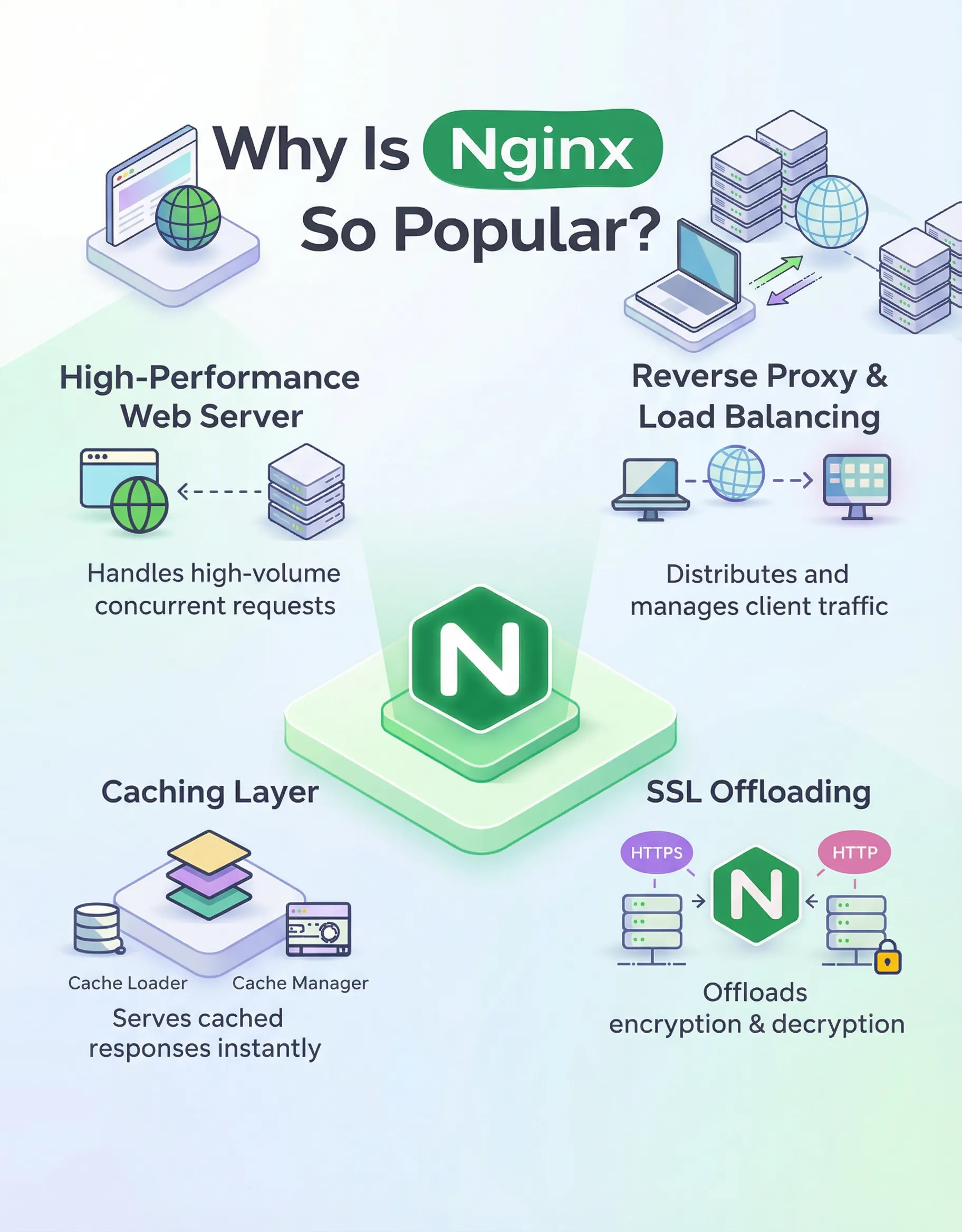
NGINX has been around for years, but it’s still powering a huge chunk of the internet. I’ve been using it for years, and here’s why it’s stuck around.
What Makes NGINX Special
High-Performance Web Server
NGINX uses an event-driven approach instead of spinning up a new process for every connection. Way more efficient.
What this means:
- Handles thousands of connections without breaking a sweat
- Uses way less memory - run more on the same hardware
- Stays fast even when traffic spikes
- Perfect for high-traffic apps serving millions of requests
Reverse Proxy & Load Balancer
Stick NGINX in front of your app servers and it handles everything - traffic distribution, load balancing, all of it.
Why this rocks:
- If a server dies, traffic automatically routes to healthy ones
- Load gets spread evenly - no single server gets hammered
- Routes intelligently - sends to closest or least busy server
- One entry point - clients just talk to NGINX, not your whole backend
Caching Layer
NGINX can cache stuff and serve it directly without touching your backend. Game changer.
The benefits:
- Lightning fast responses - cached content served instantly
- Backend breathes easier - way fewer requests to handle
- Saves money - less compute power needed
- Faster pages - everything feels snappier
Cache static content, API responses, whole pages - whatever makes sense. It’s turned slow apps into fast ones for me.
SSL/TLS Offloading
NGINX handles encryption at the edge, so your backend doesn’t have to. Trust me, this is a big deal.
Why this rocks:
- App servers focus on your app, not crypto math
- One place for certificates - manage SSL/TLS in one spot
- Better performance - specialized hardware handles encryption better
- Easier security updates - change policies in one place
Especially clutch in microservices. Managing certificates across 20 different services? No thanks. Let NGINX handle it.
Where You’ll See It
NGINX works everywhere:
- Kubernetes - Popular Ingress Controller for routing, SSL, load balancing
- Microservices - Perfect API gateway, one entry point for distributed systems
- Legacy apps - Reverse proxy that adds modern features
- Cloud platforms - Default for edge proxies and CDN
Bottom Line
NGINX solves real problems: performance, scalability, reliability, security. It’s simple, proven, and just works. That’s why it’s still powering so much of the internet - it makes web traffic fast, reliable, and secure. And honestly, that’s all most of us need.